

|

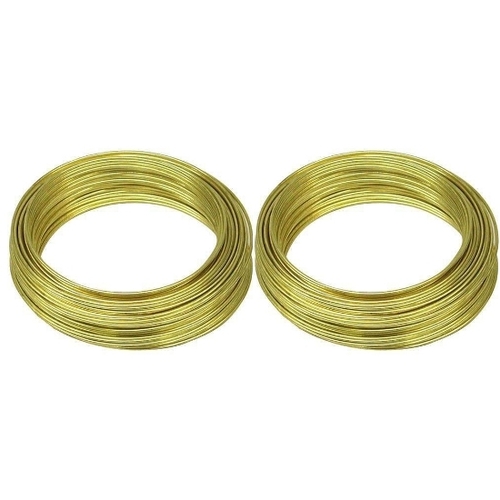
C23000 Lead Free Brass Wires
350.00 - 450.00 INR/Kilograms
Product Details:
- Type Wires
- Material Lead Free Brass
- Grade C23000
- Tolerance 0.02 mm
- Alloy C23000
- Temper Half Hard / Soft / Hard
- Length Customized
- Click to View more
X
C23000 Lead Free Brass Wires Price And Quantity
- 350.00 - 450.00 INR/Kilograms
- 250 Kilograms
C23000 Lead Free Brass Wires Product Specifications
- 0.02 mm
- 0.1 mm 6 mm
- C23000
- Half Hard / Soft / Hard
- C23000
- Available as per requirement
- Golden
- Customized
- Round
- Wires
- Lead Free Brass
- Yes
- Bright / Smooth
- Excellent
- 900C - 940C
- 8.44 g/cm3
- Coils / Spools / Bundles
- Electrical / Engineering / Fasteners / Industrial
- Good electrical and thermal conductivity
- ASTM B134 / B135
C23000 Lead Free Brass Wires Trade Information
- 20000 Kilograms Per Month
- 4 Week
Product Description
C23000 Lead Free Brass Wires
We are one of the leading manufacturer and suppliers of Lead-Free Brass Wire with the using of the high quality of material, as per the industry standards.
IS4413
CuZn37
DTD-627
60:40 Brass
| Chemical Requirements | CuZn40 | CuZn35 | CuZn37 | CuZn30 |
| Copper | 59.0 - 62.0% | 63.0 - 68.5% | 62.0 - 65.0% | 60.5 - 71.50% |
| Lead | 0.75% max | 0.05% max | 0.30% max. | 0.05% max. |
| Iron | 0.10% max | 0.05% max | 0.10% max | 0.05% max. |
| Total Imp. | 0.30% max | 0.30% max | 0.60% max | 0.30% max |
| Zinc | Remainder | Remainder | Remainder | Remainder |
| Physical Properties | ||||
| Condition | T.S. MPa | EL% Min | T.S. MPa | EL% Min |
| Annealed (O) | 325 Min | 35% | 315 Min | 45% |
| Half-Hard (HB) | 460-620 | - | 460-620 | - |
| Hard (HD) | 660-775 | - | 620 min | - |
| Fabrication Properties | |
| Capacity for being |
|
| Cold forming | Excellent |
| Machinability Rating | 40% |
| Bending | Excellent |
| Riveting | Excellent |
| Forging | Excellent |
| Uses |
| Suitable for cold Heading, Forging, End Pressing & Bending |
Uncompromising Quality and Compliance
Our C23000 brass wires are crafted to meet stringent ASTM B134/B135 standards and are fully RoHS compliant, ensuring no hazardous lead content. We supply bright, golden wires with excellent durability to support diverse industry requirements. Custom options on length, diameter, and temper are available to suit specific project needs, all delivered with precision tolerance of 0.02 mm.
Versatile Applications Across Industries
Thanks to superior conductivity, corrosion resistance, and customizable specifications, C23000 Lead-Free Brass Wires are widely used in electrical components, engineering parts, industrial fasteners, and more. Their reliable performance supports both standard and specialized manufacturing, making them a dependable choice for OEMs, suppliers, and service providers across the sector.
FAQs of C23000 Lead Free Brass Wires:
Q: How are C23000 Lead-Free Brass Wires typically used in industry?
A: These wires are commonly used in the fabrication of electrical connectors, fasteners, engineering parts, and industrial machinery. Their good conductivity and corrosion resistance make them ideal for applications requiring durable, reliable connections and components.Q: What is the manufacturing process for your C23000 lead-free brass wires?
A: The wires are produced using advanced drawing and annealing techniques, followed by a surface treatment to achieve a smooth and bright finish. Strict quality checks ensure compliance with ASTM B134/B135 standards and RoHS regulations.Q: When should I choose half hard, soft, or hard temper for these wires?
A: The temper selection depends on the end-use: soft temper is suited for pliable applications, half hard for moderate strength with flexibility, and hard temper for applications demanding high rigidity and resistance to deformation.Q: Where can I order these wires and in what packaging formats?
A: You can order the C23000 Lead-Free Brass Wires directly from our distribution network in India or through our export channels. Wires are available in coils, spools, or bundles according to your specification and convenience.Q: What are the main benefits of choosing lead-free brass (C23000) over traditional brass wires?
A: Lead-free brass ensures safety in handling and meets regulations such as RoHS. Additionally, these wires offer enhanced corrosion resistance and consistent electrical performance, making them suitable for sensitive or regulated environments.Q: How does your wires surface finish improve its performance?
A: The bright and smooth finish of our wires not only enhances their appearance but also reduces friction during manufacturing and assembly, leading to improved product longevity and easy processing.Q: What tolerance levels can I expect, and can I request customized lengths and weights?
A: All wires are produced with a precise tolerance of 0.02 mm. Length, diameter (0.1 mm 6 mm), and supplied weight can be tailored on request to fit your projects exact requirements.Tell us about your requirement

Price:
Quantity
Select Unit
- 50
- 100
- 200
- 250
- 500
- 1000+
Additional detail
Mobile number
Email

Other Products in 'Lead Free Brass Wires' category



- Shree Extrusions Limited
GST : 24AADCS0253P1Z9
- 217/218, GIDC, Phase-II, Okha-Rajkot Road, Dared,Jamnagar - 361004, Gujarat, India
- Mr. Pratik Kabra (CEO)
Mobile : +91-9825095960
Sales Department
Mobile : +91-9328105172 / 70, +91-9328105187 


- Phone :08045804979
- Mr Pratik (Director)
- Mobile :08045804979
 marketing@shree-extrusion.com
 Send Inquiry

 |
SHREE EXTRUSIONS LTD.
All Rights Reserved.(Terms of Use) Developed and Managed by Infocom Network Private Limited. |
